Future of Foraging
Honorable harvests and the circularity of custodianship
Bretagne’s coasts experience large tidal variations, producing a range of seafood - molluscs, fish, crustaceans - as well as seaweed. Estuaries like our local Goyen River have been rich food resources for the local inhabitants from the prehistoric period through to the present day (Cunfliffe, 2021). The spring tides in particular attract localized foraging, and after a few months of observation we decided to try our luck, albeit equipped with only the modest of modern tools and a decent fear of fiberglass contamination.
We went foraging once before in Portugal when we spent a week on board Spirit of Gaia, a Wharram Designs Pahi 63 owned by Hanneke Boon (watch the video below). Ryder had easily found a handfull of shellfish he and Hunter later cooked on the boat’s coal barbeque for visiting guests from the anchorage.
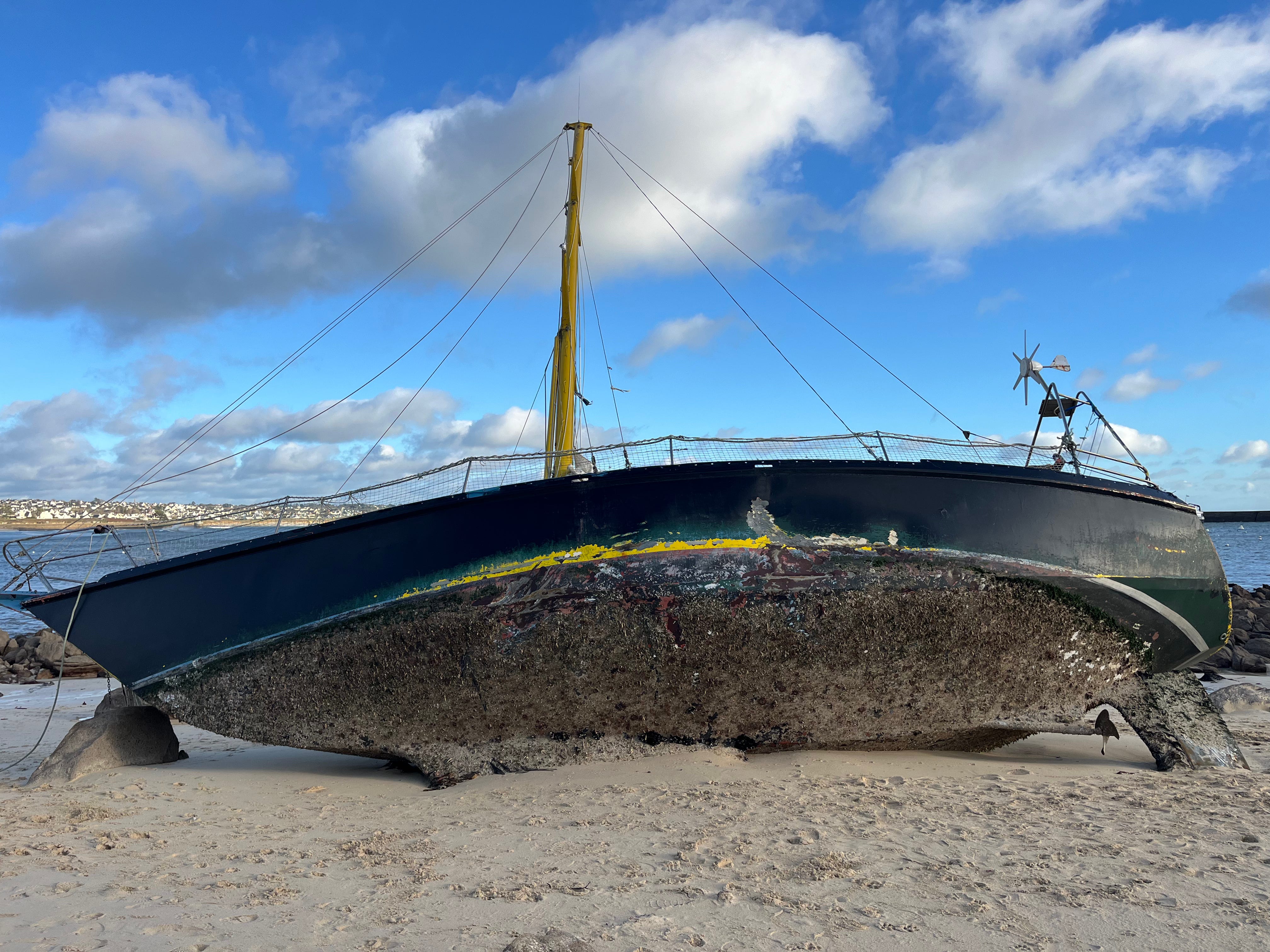
Here in Audierene, Finistere, the Goyen River is a popular spot for coastal foraging. We avoided once location in particular despite locals returning with baskets and netted bags full of shellfish; a hotspot of abandoned, wrecked and even one sunken boat litter the mudflats, which I’ve previously documented for our ‘Bad Boats’ database, the site now awaiting water sampling for fiberglass contamination.
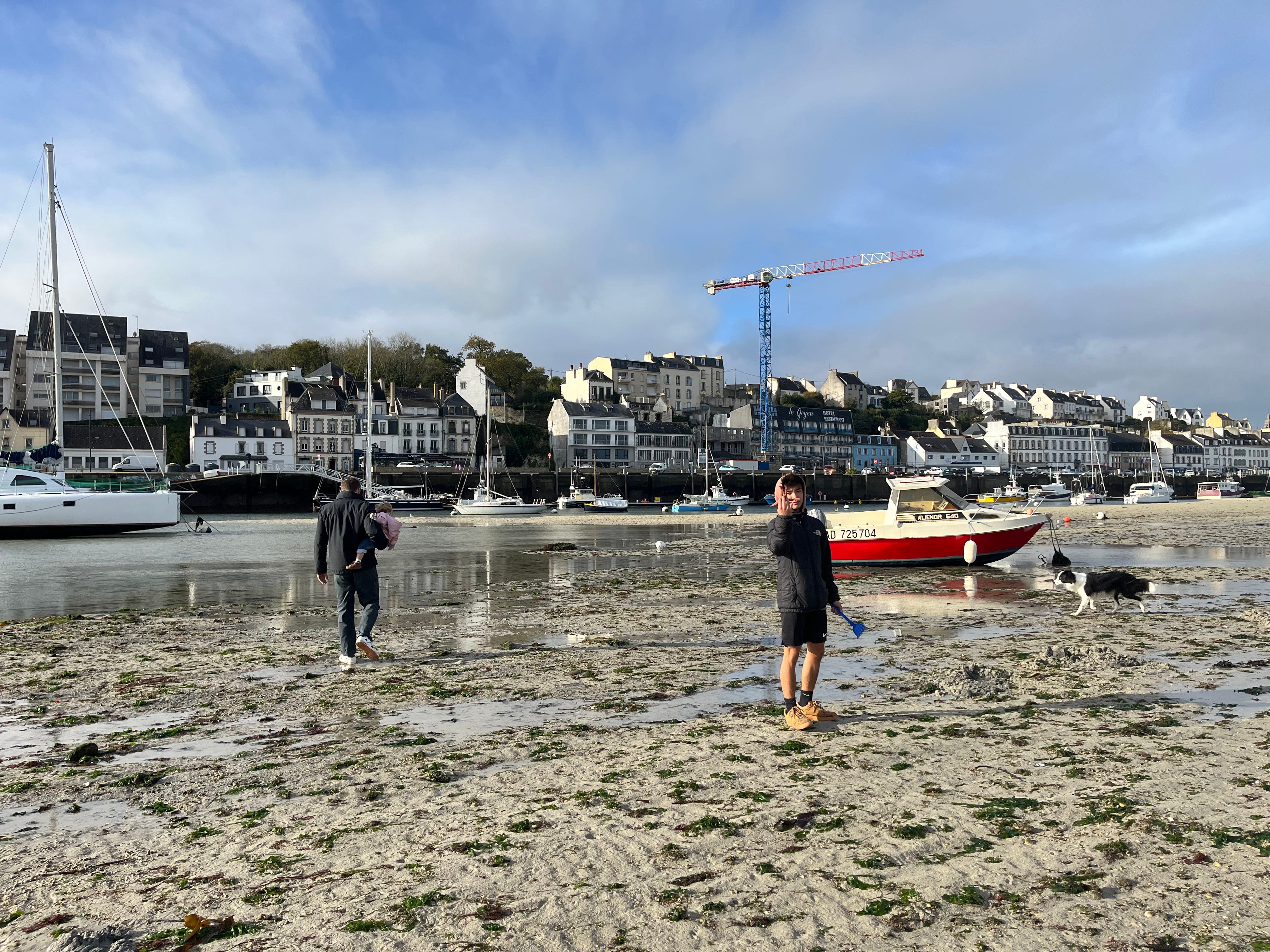
We decided to explore further downriver, just up from the marina, in front of the local fish processing facility. Admittedly, I felt nervous with this site next to a small hard-yard, where owners perch their boats for maintenance. Sanding hulls causes the spread of asbestos-like fiberglass particles into our aquatic ecosystems, and likely into our food chains (more on this below). But until I receive the sampling kit that our colleague Dr. Corina Ciocan is preparing to test for fiberglass contamination here in the river, we are taking a punt in foraging within any waterway shared by boaters. As I am the only one in the family who actually eats shellfish, Remy loves moules frites (mussels and chips) but that’s his limit, I decided to take the risk this time around. (I AM still breastfeeding, though, and as we know microplastics leach into breastmilk, its certainly a deep concern that fiberglass might, too.)
What felt important, though, was learning with the kids together as a family the ancient life skill of foraging, and with it, human-ocean kinship relations.
The Honorable Harvest
I learned the concept of the ‘Honorable Harvest’ from Robin Wall Kimmerer - mother, scientist, decorated professor, and enrolled member of the Citizen Potawatomi Nation - in her extraordinary book Braiding Sweetgrass (2020). Reading it during the pandemic lock downs whilst ‘learning-while-doing’ permaculture with Remy on his parents’ plot of land, I reminded myself of what I learned in the book and ahead of our shellfish gathering explained to the kids that we were to be gentle in our search for food and sure not to take more than we needed.
As Kimmerer writes, the guidelines for the Honorable Harvest “are not written down”, but they might look like this (based in the author’s example of foraging leeks for dinner - I’d never suggest anyone take half of available seafood. Use your common sense.):
Know the ways of the ones who take care of you, so that you may take care of them.
Introduce yourself. Be accountable as the one who comes asking for life.
Ask permission before taking. Abide by the answer.
Never take the first. Never take the last.
Take only what you need.
Never take more than half. Leave some for others.
Harvest in a way that minimizes harm.
Use it respectfully. Never waste what you have taken.
Share.
Give thanks for what you have been given.
Give a gift, in reciprocity for what you have taken.
Sustain the ones who sustain you and the earth will last forever.
Despite having high hopes of finding razor clams, the kids’ beach-set consisting of a plastic bucket, spades and rakes we’d found in the garage of our current rental were not sufficient in uncovering these creatures that bury themselves rapidly and beyond a metre deep. We observed a local woman salting for the long, thin clams, where food grade salt, usually in the form of a brine made with seawater, is applied to a razor clam burrow irritating the razor clams so that they emerge from the sediment and can be manually retrieved. We had also learned of this technique on YouTube, and brought a small bottle of salt to test it out, to no avail. Instead, we got lucky when we stumbled upon two razor clams in a murky, disrupted sandy pool where an elderly man had been digging previously with a pitch fork.
(Upon sitting to write this story, I’ve since learned that the salting method is somewhat controversial. Limited laboratory studieshave suggested applying a high salinity brine to extracted razor clam gill tissue (Krzyzewski and Chery 2005) or juvenile razor clams (Harrigan 2014) can either cause noticeable tissue damage or hinder ability to recover and rebury, respectively. Field investigations with razor clam species in Europe suggested an intertidal razor clam fishery with salt could be considered “environmentally friendly” in Portugal (Constantino et al 2009), and another describing the subtidal diver salting razor fishery in Scotland as having limited impact on small discards (Muir 2003). Field-based studies on potential effects of salting as it pertains to the local razor clam fishery have been lacking.)
What we found in abundance with our bare hands and flimsy plastic spades were cockles. Delicious in soups and pastas, I’d eaten cockles a plenty during the decade I lived on the Pacific Coast of Japan. Good practice is to pluck cockles 3cm or bigger, and with that in mind the boys started to fill our humble little bucket. We uncovered a few lonely mussels and clams from the sand, too, to top off our catch. With the bucket almost full, and Sahara soaking wet from her own explorations, we called it a morning and trudged up the boat ramp towards the car. Dumped over the side of the boatyard were empty shells of what I had really hoped we might find, giant scallops! Unfortunately, not enough were left by the morning’s earlier foragers for us to share in.
The Joy of Cooking What We Catch
A key reason we relocated to Bretagne to build the boat was to begin immersing ourselves in a simple, coastal way of life similar to that which we will be living aboard our wooden double canoe. As I said, we had a taste of cooking what we catch down in Portugal, and even if the others don’t love shellfish in the way I do, there’s still a shared sense of joy and kinship in collecting food and preparing to cook it as a family.
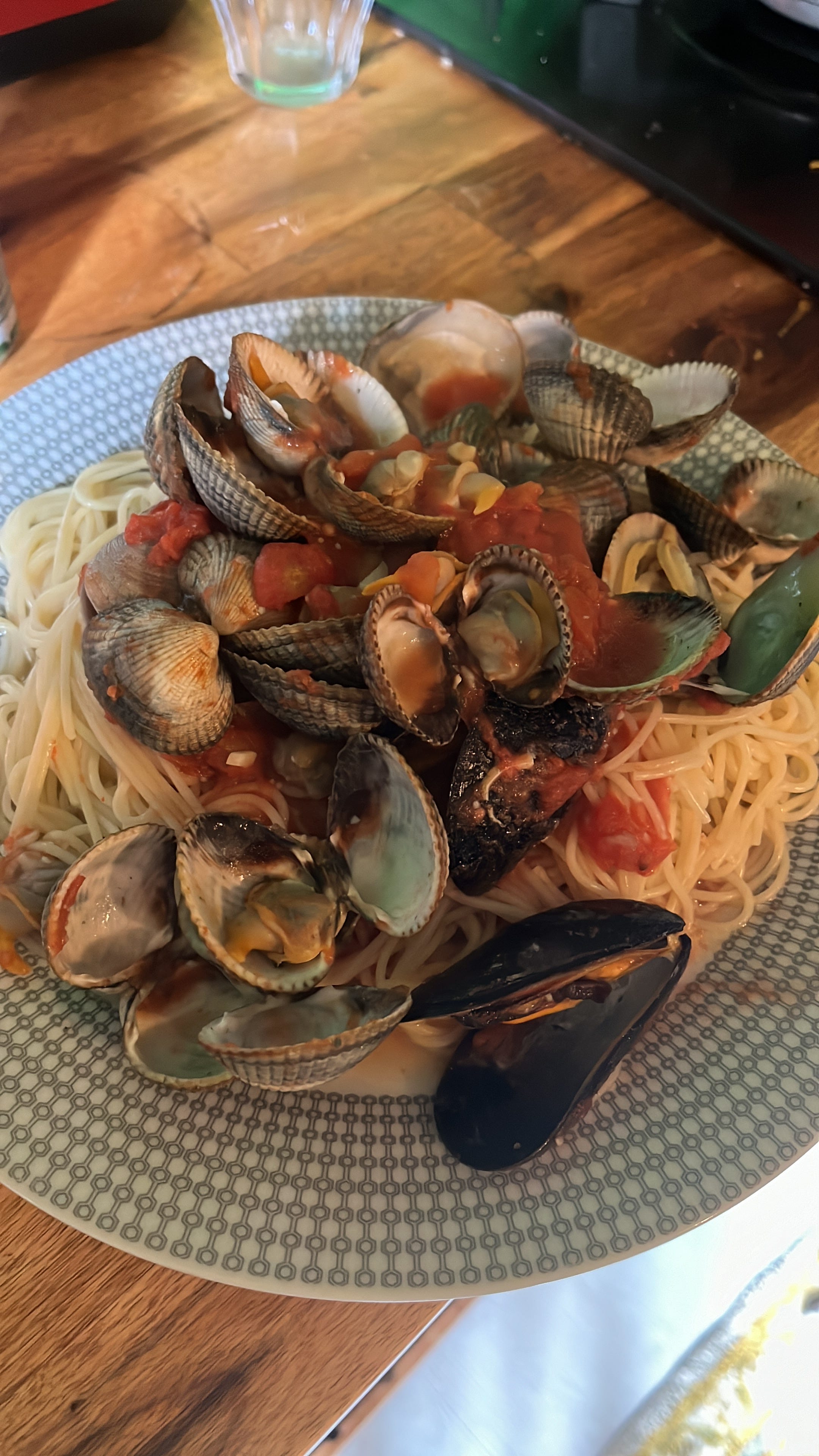
I opted to make a simple tomato sauce pasta, as we already had the basic ingredients on hand. I started by soaking the shellfish in salted water, rinsing them thoroughly to remove sand and sediment. Next, I cooked the bivalves in butter and garlic, then added chopped tomatoes, paprika, wild garlic chives, salt, and pepper. After mixing everything, I lowered the heat, covered the pan, and let it simmer for a few minutes, while the spaghetti boiled in a pot alongside.
Remy came to sample one of the mussels, but otherwise I felt spoiled in this special meal. Alongside being absolutely delicious, this was a meal provided for by the entire family and our ocean kin, and I did not waste a bite, enjoying my lunch with a cold glass of a local Breton brew at home.
Kinship Connection
With every breath, with every sip of water, with every meal, we are reminded that our lives are inseparable from the life of the world - and even the cosmos - in ways both material and spiritual. - Humans & Nature Press. (2021). Kinship: Belonging in a world of relations.
I believe we all have, within our reach, access to traditional ecological knowledge - simple acts like foraging for food in community - that can guide us towards regenerative futures and better ways of kinning. Humans are a migratory species, and like millions of others around the world, some by choice and some for survival, we too have come to live in new lands. I don’t believe we need to be indigenous to a place to become ‘naturalized’ to it; we are ALL indigenous to Planet Ocean and with that mindset, have the capacity to be better kin. As Kimmerer writes:
Being naturalized to a place means to live as if this is the land that feeds you, as if these are the streams from which you drink, that build your body and fill your spirit…to live as if your children’s future matters, to take care of the land as if our lives and the lives of all our relatives depend on it. Because they do.
Foraging for cockles, clams and mussels is not just about gathering food. As the boys and I watched the bivalves react to salt we’d added to the bowl of water at home prior to rinsing them, we were fascinated in their behaviour, poking their long, slimy flesh out of their shells before retreating again. Foraging our own food immerses us in the living systems we humans are a part of, connecting with other-than-human kin in ways that can remind us of the impact we can have on our Planet, both positive and negative.
The Importance of Bilvalves
Thanks to our collaboration with Dr. Corina Ciocan at the University of Brighton, we now know that bivalves are filter feeders, sometimes dubbed the ‘lungs of the sea’, removing excess nitrogen from waters by incorporating it into their shells and tissue as they grow. This means they also indiscriminately ingest contaminants like minuscule particles of fiberglass, as Corina and her research team discovered in samples taken from Chichester Harbor in the UK.
Fiberglass ingestion thus poses a severe threat to marine bivalves like oysters and mussels as it can impair their health and even lead to death. Over time, this could lead to a decline in their populations, which would have a ripple effect throughout the marine ecosystem. We will have to wait for medical scientists to begin researching the impacts on humans from fiberglass entering our food chains, but from what we know about microplastics.
Sailing for Solutions
One of the goals of our collaboration is to bring the issue in to the public consciousness, and it’s my personal ambition to inspire artists, designers, storytellers, creatives and citizens to help drive change. Place-based experiences feel particularly important, be it a Sunday with the family out foraging or taking part in an regenerative tourism experience. We follow the Coastal Exploration Company in Norfolk on Instagram. They offer a foraging exploration taking guests aboard traditional wooden sailboats to forage for samphire, cockles, fish and other local delicacies.
Our Regenerative Tides: Sailing for Solutions initiative aims to help bring people together on this issue, including through the citizen-driven ‘Bad Boats’ database. As we walk around our communities, or visit new regions as sailors, we can come together to collect data and map end-of-life boats with just a smart phone, helping scientists to identify hot spots for conducting further research whilst also raising public awareness and driving policy change.
Some readers may wonder why we don’t simply avoid eating seafood if we’re concerned about fiberglass contamination? I want to gently take you back to beginning of this newsletter:
Estuaries like our local Goyen River have been rich food resources for the local inhabitants from the prehistoric period through to the present day.
This is true also for coastal communities around the world, many whom fish and forage sustainably, like our friends on Gau Island, Fiji, and our local Breton neighbors here in France. Indigenous peoples in places like Australia similarly harvested oysters sustainably for thousands of years before colonisation.
Author Tyson Yunkaporta once used the phrase ‘remembering forward’ when talking to me about the potential for everyone to learn from traditional ecological knowledge. With curiosity and patience, I believe we can come full circle to move forward, filling our little buckets with an Honarable Harvest, enjoying the rewards whilst giving thanks - the pleasure of spending time on or beside the sea, remembering the ancient practice of foraging for food, contributing to science and political change, envisioning regenerative futures so our children can thrive on a flourishing planet.
Thank you for being here, we really appreciate it. And thank you so much to our paid subscribers for going the extra mile. If you have the capacity, please upgrade to a paid subscription to further support our work.
Angie, Remy, Ryder, Hunter, Sahara and Sage xx
About last night…
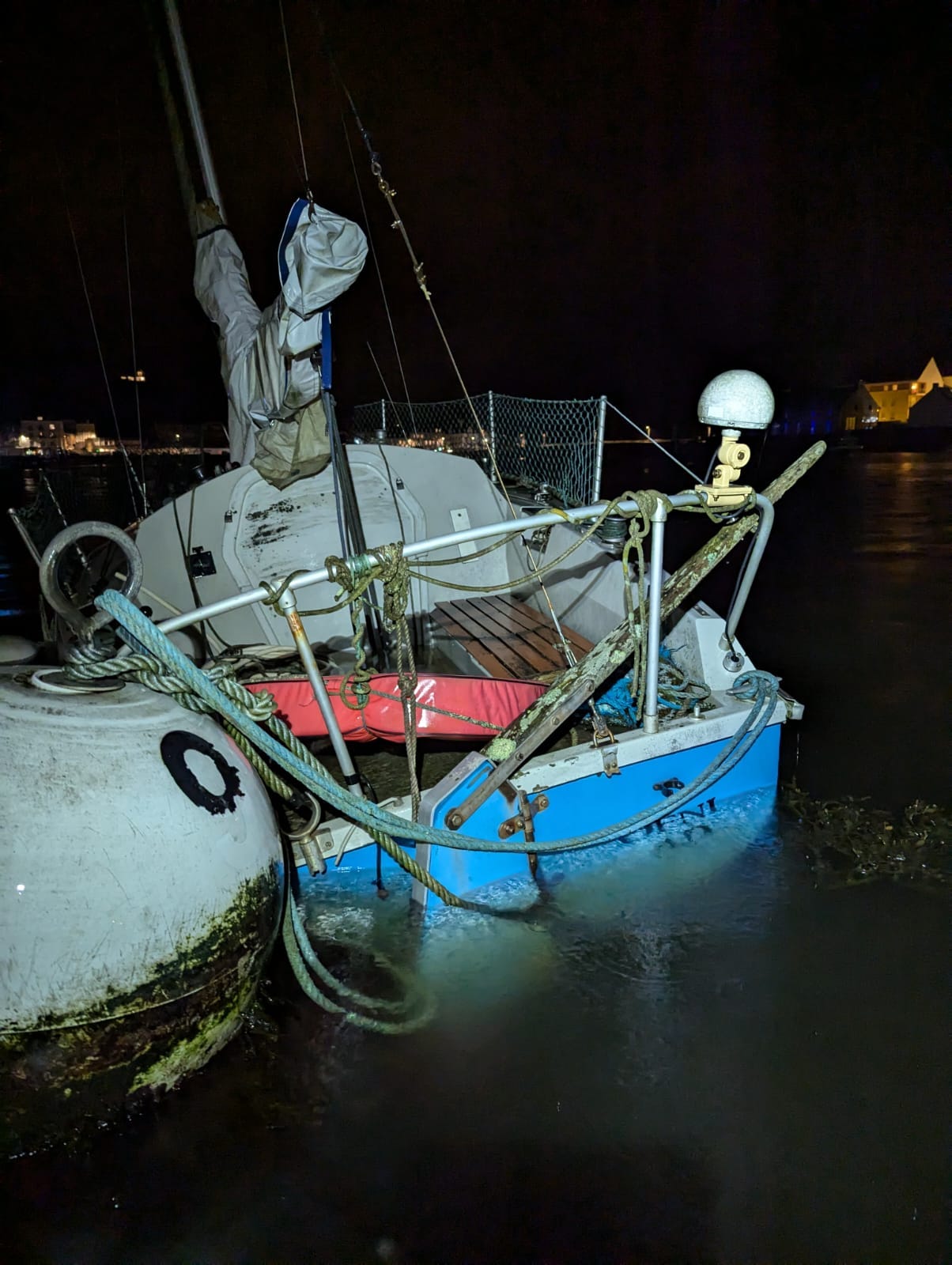
As I was writing this newsletter last night, Remy and the boys came home from the laundromat in town with some news: “There’s a boat in the harbour sinking,” Hunter exclaimed. We’d had some heavy rain but surely not enough to sink a boat? I texted our friend Luc, whose boat lies on the same mooring line. With the harbour master offline, he went down to take a look himself. Rowing out in his small dinghy, he discovered the boat indeed sinking. Taking a peak through the porthole, he saw the inside full of water, things floating around everywhere, and could smell gasoline. “It doesn’t look like its being taking good care of,” Luc wrote to me.
Driving past this afternoon, the boat was no longer in the water and had been moved to the hard yard. Perhaps it will be salvageable. This is just one example of how boats often end up sunken or littered on the shore, when they are neglected and left on moorings or at anchor for what can be years - even decades. Storms batter vulnerable vessels, which can break up, sink, or end up on the shore. Removing submerged boats is typically a tremendously expensive ordeal, costing taxpayers up to the tens of thousands. If your boat is nearing its end-of-life, its better to learn how to dispose of it responsibly.